The Aesthetic of Authority: How McKinsey, The Financial Times, and The Economist Design for Trust
In business intelligence, the visual presentation of information acts as a cognitive enforcement mechanism - a strategic tool that establishes authority, ensures retention, and signals rigorous analytical provenance.
This guide provides an analysis of the design principles that construct "authoritative visual appeal," examining how typography, color theory, grid systems, and data visualization standards converge to create a feel of undisputed trust at three elite institutions: McKinsey & Company, The Financial Times, and The Economist.
In This Guide:
1. Typography: The Voice of Data
Robert Bringhurst, in The Elements of Typographic Style, describes typography as "tribal customs" that signal belonging to a civilized discourse - a tongue distinct from speech, through which authority speaks visually rather than verbally.
The "Serif Credibility" Effect
Research indicates that font choice triggers immediate emotional and cognitive responses. The most famous demonstration of this is the "Baskerville Effect" - an experiment conducted by documentarian Errol Morris and Cornell psychologist David Dunning with 45,000 New York Times readers. Participants were shown identical statements in different fonts (Baskerville, Comic Sans, Computer Modern, Georgia, Helvetica, and Trebuchet). Readers were statistically more likely to agree with statements written in Baskerville, a serif font. While the advantage was 1.5%, Dunning noted that in large-scale contexts like elections or marketing campaigns, such a shift in persuasion is "huge."
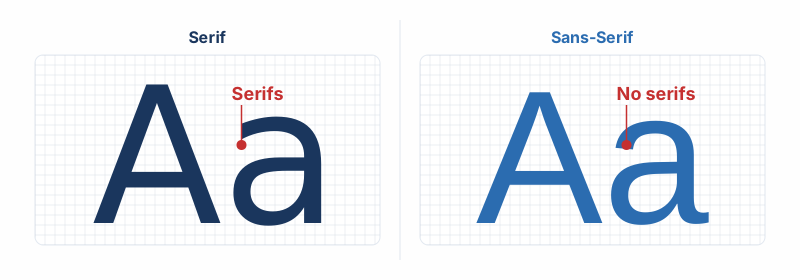
Professional contexts show even stronger effects. A 2024 study found that 67% of hiring managers associate serif fonts with trustworthiness, while documents using standard professional typography see engagement rates increase by up to 40% compared to decorative alternatives. Serif fonts signal history, academia, and permanence; sans-serif fonts signal modernity, approachability, and digital utility.
How the Three Institutions Use Typography
All three institutions follow the same pattern: custom serif fonts signal exclusivity and permanence, while sans-serif fonts provide utility and modernity. The custom nature of these fonts is crucial - they are voices that cannot be replicated by default software, creating instant brand recognition and signaling investment in quality.
McKinsey
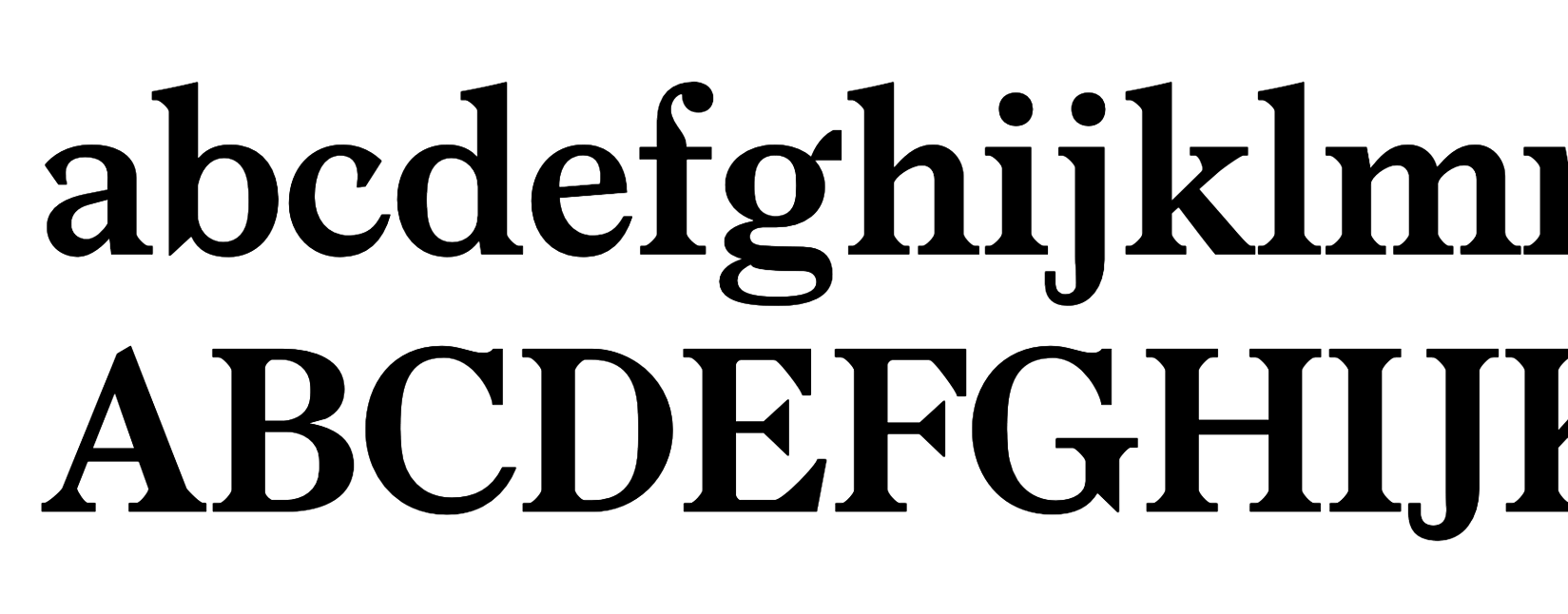
Bower - a custom serif named after Marvin Bower, the "father" of modern management consulting. The font is characterful and bold, with a slight "chiseled" quality that suggests permanence and gravitas. Paired with McKinsey Sans for body text.
Pragmatic Concession: Allows Georgia and Arial in PowerPoint presentations to ensure files don't break when shared with clients - reliability over purity.
"A broken font file undermines authority more than a generic font does."
Financial Times
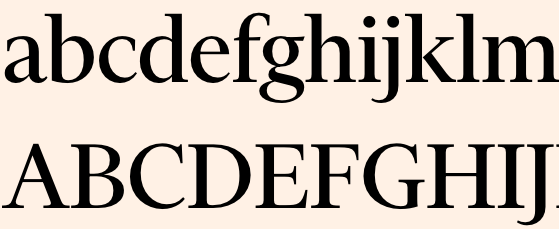
Financier - a custom serif commissioned in 2014, designed specifically to handle the density of financial news while signaling modernity. Lacks ball terminals (common in newspaper fonts) for a "sharper, more incisive" feel.
Performance Focus: Optimized for web speed - the font loads in milliseconds, ensuring that "authority" renders instantly on digital screens.
Two variants: Financier Display for headlines, Financier Text for body copy.
The Economist
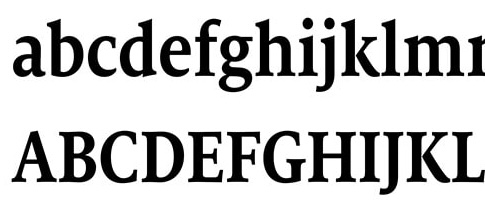
Milo Serif for body text - chosen because it was "cut for optimal legibility in both digital and print environments." Features more upright oval shapes and modern style with variance in strokes. Paired with Econ Sans (a customized version of Halifax) for headers and charts.
2018 Redesign: The first redesign in 17 years, replacing ITC Officina Display and New Eco. Art director Stephen Petch: "The new typefaces give pages an airier, less forbidding feel."
Econ Sans has uniform stroke width for readability across all sizes - part of a multi-year effort to align web and print typography.
Logo Typography: Tribal Signaling
Typography choices in logos reveal which "tribe" a company wants to belong to. Compare two of the Big Three consulting firms: McKinsey uses a classic serif wordmark, while BCG uses a bold geometric sans-serif. Both are elite strategy consultancies, but their typography signals membership in different worlds.
McKinsey's serif wordmark signals: "We are the established authority - the firm that has advised governments and Fortune 500 CEOs for a century." BCG's geometric sans-serif signals: "We are the future of consulting - innovative, tech-forward, and ready for digital transformation." Neither is "better" - they're optimized for different positioning strategies.
Our take on fonts
The most authoritative brands use a hybrid approach to balance permanence and modernity: serif for deep reading and headlines (signaling heritage and expertise), and sans-serif for data, navigation, and utility (signaling efficiency and clarity). This pairing creates a visual system that feels both trustworthy and contemporary.
2. Color as Strategic Signal
Color is never decorative in authoritative design - it is functional. It signals identity, conveys meaning, and directs attention. Each institution has transformed color into a trust signal.
Signature Colors and Their Psychology
McKinsey Deep Blue
Hex: #053259
A profound, almost midnight blue set against stark white. This high contrast symbolizes "clarity of thought" and the ability to "cut through" noise.
Psychology: Universally associated with stability, intelligence, and authority - the color of law, banking, and the state.
FT Salmon Pink
Hex: #fff1e0
Introduced in 1893 for cost efficiency (unbleached paper was cheaper), this color became a premium signal over 130 years. Carrying the "pink paper" signals financial expertise.
Psychology: The specific "bisque" shade is easier on eyes than stark white, enabling longer reading times.
Economist Red
Hex: #E3120B
A sharp, bright red used strategically as an accent to highlight key data points. Links directly to the brand's red logo, creating instant recognition.
Psychology: Red "pops out" against cool blues and beige backgrounds, leveraging the psychological "pop-out effect" to direct attention.
Our take on color
Pick one signature color and use it consistently. Don't chase trends - the FT's salmon pink started as a cost-saving measure and became iconic through 130 years of consistent use. Your color palette should be functional first: use color to direct attention, not to decorate. For more on effective color usage, see our guide on how to use colors in charts.
3. Grid Systems as Intellectual Architecture
The Swiss Style, championed by Josef Müller-Brockmann, established the grid system as the fundamental tool for organizing information objectively. A strict grid implies that information has been rigorously sorted and categorized, while providing cognitive ease by allowing readers to predict where information will appear.
How Grid Systems Create Authority
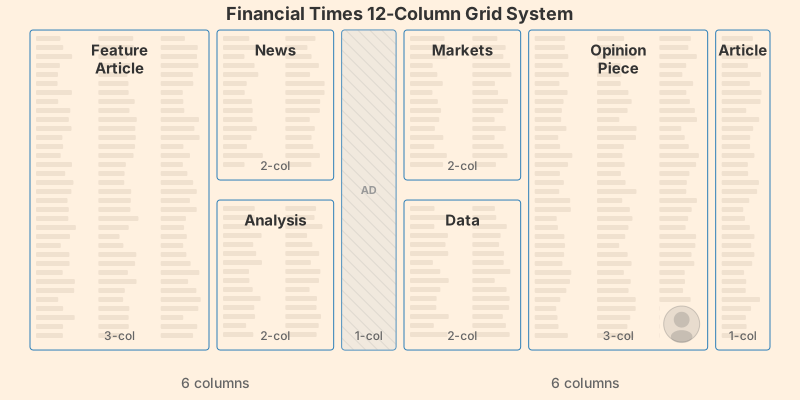
Financial Times: The 12-Column Responsive Grid
The FT employs a sophisticated 12-column grid system (part of their "Origami" design system) that spans across 2-page spreads in print (6 columns per page). Content can span variable widths:
- 3-column: Major feature articles
- 2-column: Standard news stories
- 1-column: Narrow sidebars, ads, pull quotes
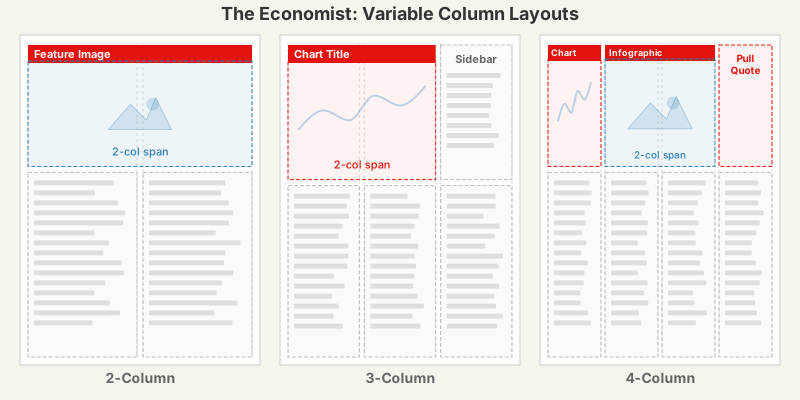
The Economist: The Compact Column Grid
Charts typically span one narrow column width, forcing extreme economy of space. This constraint drives the "poster aesthetic" - charts must be punchy and self-contained.
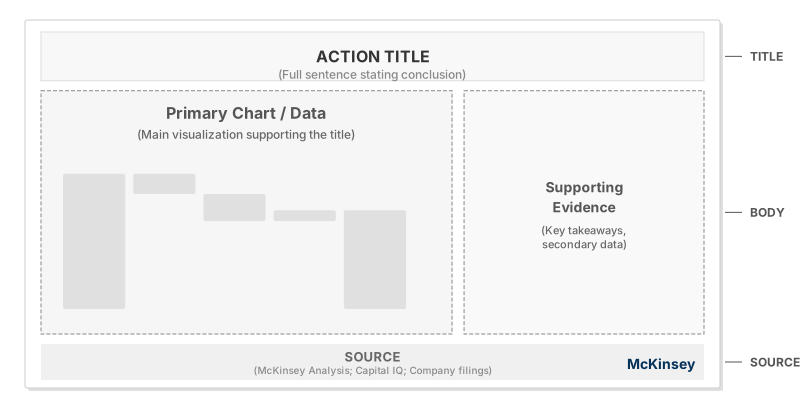
McKinsey: The Slide Grid
McKinsey slides follow a rigorous three-part structure:
- Action Title (top) - full sentence stating the conclusion
- Body (middle) - charts/infographics with supporting evidence
- Footer (bottom) - source attribution (e.g., "McKinsey Analysis | Capital IQ")
Our take on grids
Establish a grid and never break it. Whether it's a 12-column system or a simple thirds layout, consistency creates the perception of rigor. Your audience may not consciously notice the grid, but they'll feel its absence as "something off" when you deviate.
4. Data Visualization: Theory and Practice
Graphical Integrity and the Tufte Doctrine
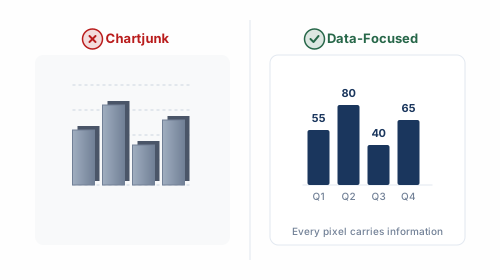
The Data-Ink Ratio Principle
Edward Tufte's foundational concept states that every pixel should either display data or support data comprehension. The formula is simple:
Data Ink (Keep)
- • Bars, lines, points
- • Essential labels
- • Critical axis marks
Non-Data Ink (Remove)
- • Decorative borders
- • Excessive gridlines
- • Redundant colors
Tufte's Six Principles for Graphical Integrity
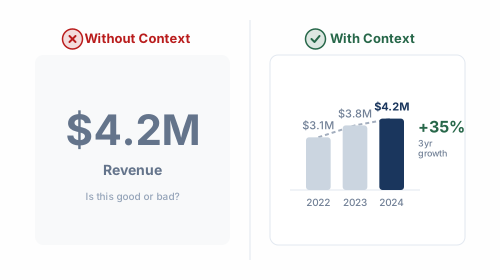
Read full article →1. Comparisons
Data must be shown in comparison to dependent variables. An isolated number is meaningless.
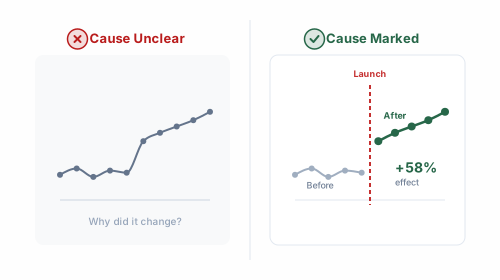
2. Causality
The design must demonstrate how independent variables impact dependent variables.
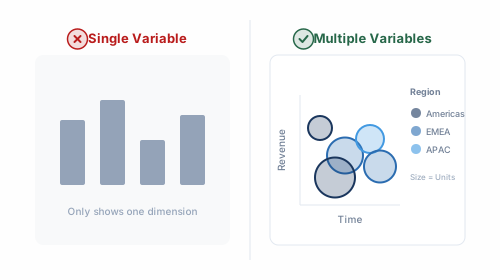
3. Multivariate Analysis
Authority comes from showing complex, multi-variable relationships.
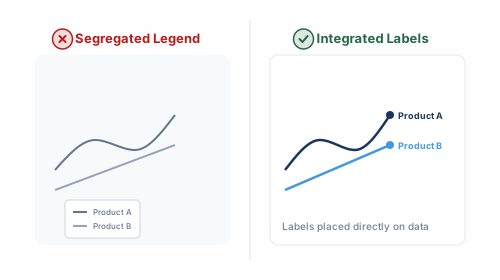
4. Integration
Text, maps, and numbers must be integrated, not segregated.
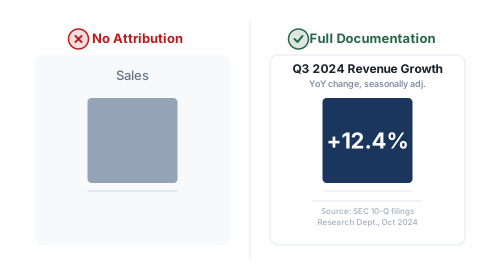
5. Documentation
Credibility requires attribution and detailed titling.
6. Content Focus
The design must serve the content, not the designer.
Approaches: Designing for Different Goals
Each institution uses data visualization to solve a different rhetorical problem. Their approaches reveal distinct philosophies about the relationship between data and insight.
| Financial Times | McKinsey | The Economist | |
|---|---|---|---|
| Authority Type | Editorial Authority | Interpretive Authority | Editorial Authority |
| Philosophy | Authority comes from removing bias to show pristine data. The reader draws their own conclusions from expertly curated information. | Authority comes from adding layers of interpretation. Action titles, arrows, and annotations guide the executive to the "right" conclusion. | Authority comes from removing bias to show pristine data. The reader draws their own conclusions from expertly curated information. |
| Primary Goal | Reporting & Analysis | Persuasion & Action | Insight & Wit |
| Title Style | "US Inflation, 2000-2024" | "Profit fell 15% due to supply chain disruptions" | "The Long Climb Back" |
| Chart Complexity | Variable (prioritized by statistical validity) | High (Waterfall, Marimekko, Bubble) | Compact (Line, Bar, Slope) |
| Data-Ink Philosophy | Pure Data - strict Tufte adherence | Interpretive Ink - adds arrows, kickers, annotations | Editorial Minimalism - strips to essence |
Our take on data visualization
Know your purpose. If you're persuading executives, use McKinsey's interpretive approach with action titles. If you're informing readers, use the FT/Economist's editorial restraint. The worst charts try to do both - they either obscure data with opinion or fail to guide the audience to insight.
Final Thoughts
For designers seeking to emulate this authority, the lesson is clear: Restraint, Consistency, and Hierarchy. Every pixel must serve the argument. Visual appeal comes not from what is added, but from the rigorous logic of what remains.
Authority is the absence of noise.
Create Authoritative Charts in Google Slides
Professional, publication-quality charts with sophisticated styling, custom palettes, and advanced chart types.